Greenhorn
The Captain and Ann BarbaraIn The Promised Land, the word "greenhorn" is the first American lesson Mary Antin records, and it is a lesson in shame. On the journey from the pier to Wall Street, crowded with her family into a rickety cab, her father found occasion to instruct or correct them even before they reached their new home, telling them not to lean out of the windows, not to point, and explaining the word "greenhorn." The children did not want to be greenhorns and gave the strictest attention to his instructions. The word thus enters the narrative as a prohibition and a warning, the name of everything the family must not be, and the first term of their American education is the recognition of their own inadequacy as measured by American eyes.
The Greenhorn's Clothing and the Erasure of the Old Self
The greenhorn state was written most visibly on the body, in the homemade European costumes that pointed the children out to the children on the street. The kind people who assisted the family in their first American weeks formed a group by themselves in the gallery of Mary's friends, and among them was a fairy godmother who led the children to a wonderful country called "uptown," where, in a dazzlingly beautiful palace called a "department store," they exchanged their hateful homemade European costumes for real American machine-made garments, and issued forth glorified in each other's eyes. The despised immigrant clothing was shed along with the impossible Hebrew names. A committee of friends, several years ahead of the family in American experience, put their heads together and concocted American names for them all, ruthlessly discarding those real names that had no pleasing American equivalents, content if they retained the initials. Mary's mother, possessing a name that was not easily translatable, was punished with the undignified nickname of Annie; Fetchke, Joseph, and Deborah issued as Frieda, Joseph, and Dora; and Mary herself was simply cheated, her Hebrew name Maryashe, shortened to Mashke and Russianized into Marya, being judged to hold good in English as Mary, which was very disappointing, as she longed to possess a strange-sounding American name like the others. The greenhorn's clothing and the greenhorn's name were twin markers of foreignness, and both had to be discarded before the family could begin to pass as American.
The Greenhorn in the Schoolyard and on the Street
The word followed the children beyond the family circle, wielded by other children as a weapon of exclusion. On the beach at Crescent Beach, a girl was mocked by a tormentor who called after her, "Say, you greenhorn, why don'tcher look?" after she had refused to walk with him, and the girl kept straight on, vowing that she would never walk with that rude boy again, neither by land nor sea, not even though the waters should part at his bidding. The insult was a daily hazard of immigrant childhood, and the family's response was diligent instruction. The interval on Union Place was crowded with lessons and experiences: they had to visit the stores and be dressed from head to foot in American clothing, learn the mysteries of the iron stove, the washboard, and the speaking-tube, learn to trade with the fruit peddler through the window, and not to be afraid of the policeman, and above all, learn English. So diligent were they under instruction, so adaptable, and so clever in hiding their deficiencies, that when they made the journey to Crescent Beach in the wake of their small wagon-load of household goods, Mary's father had very little occasion to admonish them on the way, and she was sure he was not ashamed of them. So much they had achieved toward their Americanization during the two weeks since their landing.
The Father's Americanization and the Greenhorn's Opposite
The greenhorn was defined against the figure of the father, who had arrived three years before the rest of the family and had already ceased to be one. Almost his first act on landing on American soil had been his application for naturalization, and he had taken the remaining steps in the process with eager promptness, becoming a citizen of the United States at the earliest moment allowed by the law. The boasted freedom of the New World meant to him far more than the right to reside, travel, and work wherever he pleased; it meant the freedom to speak his thoughts, to throw off the shackles of superstition, to test his own fate, unhindered by political or religious tyranny. He was only thirty-two when he landed, and most of his life he had been held in leading-strings; he was hungry for his untasted manhood. Yet even he had made a number of false starts in business during his three years of probation, and his history for that period was the history of thousands who come to America with pockets empty, hands untrained to the use of tools, minds cramped by centuries of repression in their native land. The greenhorn's opposite was not the native-born American but the naturalized citizen, the man who had passed through the greenhorn state and emerged with citizenship papers in his bosom.
The Greenhorn's World and the Persistence of the Slum
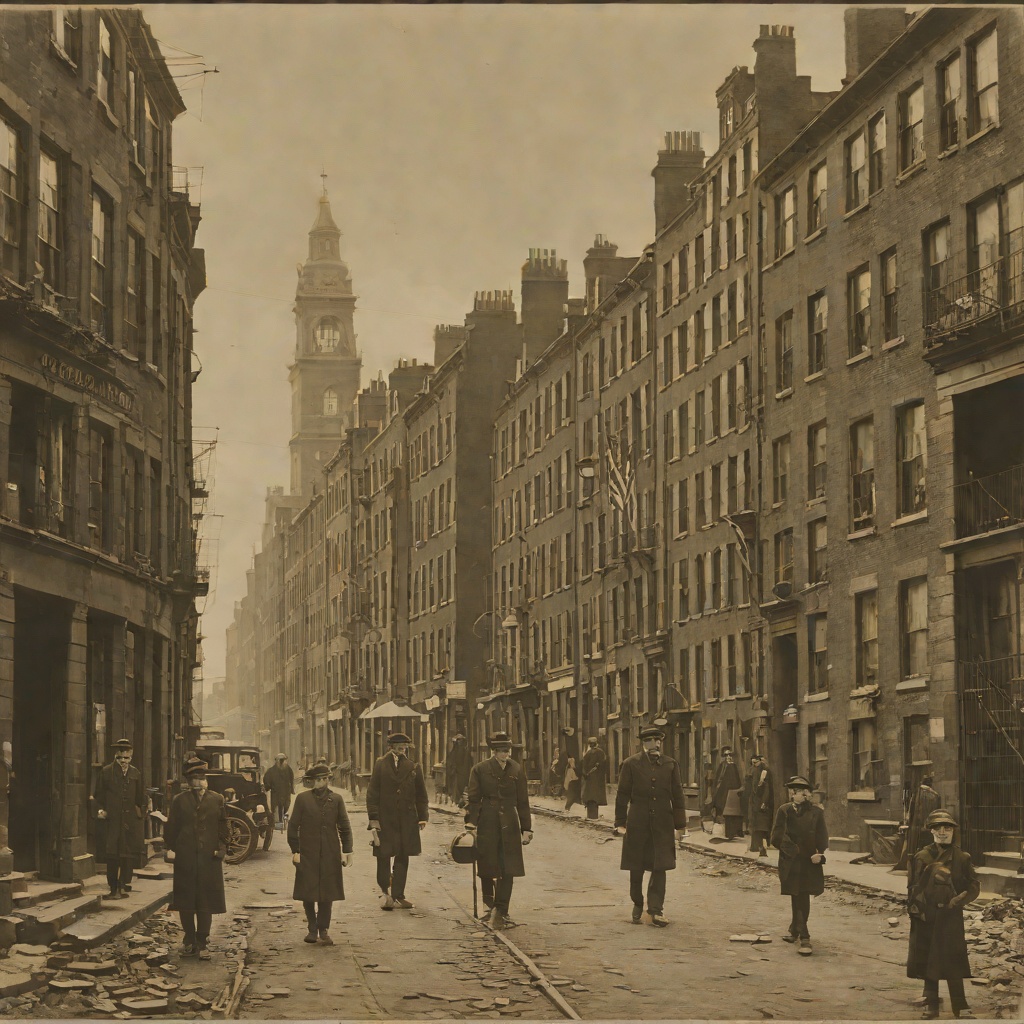
The greenhorn state was not merely a personal condition but a geography. The family's successive homes traced a path through the immigrant districts of Boston, from the three small rooms up one flight of stairs on Wall Street, with their lean mattresses, wooden chairs, and mysterious iron stove, to the basement grocery on Wheeler Street in the lower South End, where there were rather more Negroes than there had been on Arlington Street, and finally to Dover Street, intersected near its eastern end by Harrison Avenue, the heart of the South End ghetto. The greenhorn's world was one where the multifarious business of Harrison Avenue burst through the narrow shop doors and overran the basements, the sidewalk, and the street itself in pushcarts and open-air stands, and where the multitudinous population burst through the greasy tenement doors and flooded the corridors, the doorsteps, and the gutters, pushing in and out among the pushcarts all day long and half the night besides. Even Passover could not quite cleanse this street, for although the tenements might be scrubbed to their remotest corners, the cleansing stopped at the curbstone, and a great deal of the filthy rubbish accumulated in a year was pitched into the street, often through the windows. The greenhorn's journey out of the slums was also a journey out of the greenhorn state, and Mary's later life, from her bare room overlooking the lumber-yard to the satin drawing-rooms of the Back Bay where she drank afternoon tea with gentle ladies, was the measure of how far she had traveled from both.
The Greenhorn as Origin and the Price of Transformation
The greenhorn state, for all its shame, was the necessary origin of the American self, and the memoir returns to it again and again as the point of departure. The word's power lay in its ability to name the gap between the old world and the new, and the family's Americanization was the process of closing that gap. Yet the process had its costs, levied on every immigrant Jewish household where the first generation clings to the traditions of the Old World while the second generation leads the life of the New. Mary's mother, who had not the initial impulse to depart from ancient usage that her father had in his habitual scepticism, gradually divested herself at his bidding of the mantle of orthodox observance, but the process cost her many a pang, because the fabric of that venerable garment was interwoven with the fabric of her soul. The father kept the store open until Sunday morning while the mother might light the consecrated candles on Sabbath eve, and on the holy days he bought her a ticket for the synagogue but sent the children to school. The greenhorn's transformation was thus not a simple shedding of the old self but a disorganization of family life, and the memoir's final note is one of hope tempered by the recognition of what was lost. The greenhorn who learned to think in English without an accent, who went to Barnard College instead of Radcliffe, who earned enough to pay Mrs. Hutch the arrears and satisfy all her wants, remained aware that the climax of her personal drama was still to be recorded by her grandchildren, and that the faith of Israel was a heritage that no heir in the direct line has the power to alienate from his successors.